
A transcript isn't a photocopy of a return. The IRS maintains all tax records as transcripts - it does not maintain full copies of filed tax returns, such as Forms 1040 or 1120 for electronic access.
This article explains the types of transcripts the IRS maintains, the purpose of each, and how far back it keeps them. With your clients' permission, TaxStatus can retrieve each of the records described below. We extract the information that is relevant to providing financial guidance to your clients.
Before You Begin
- Transcript availability depends on the taxpayer's filing history — some transcript types only exist if the taxpayer has filed a return or if account activity exists.
- For married couples filing jointly, Account Transcripts, Tax Return Transcripts, and Record of Account Transcripts are identical for both spouses if a joint return has been filed. Wage & Income Transcripts are always unique to each individual.
Tips
- It is best practice to collect transcripts for both spouses, even if they are married filing jointly - this allows visibility into all income sources.
- Transcripts partially mask personally identifiable information to protect the taxpayer. Financial data remains fully visible to allow for tax preparation, tax representation, and income verification.
What is on an IRS Transcript?
The IRS protects taxpayer information by partially masking personally identifiable information on specific transcripts. Information that may be hidden includes full tax ID numbers, full legal names, and full addresses.
A transcript displays information unique to each type of tax transcript.
Access Transcripts
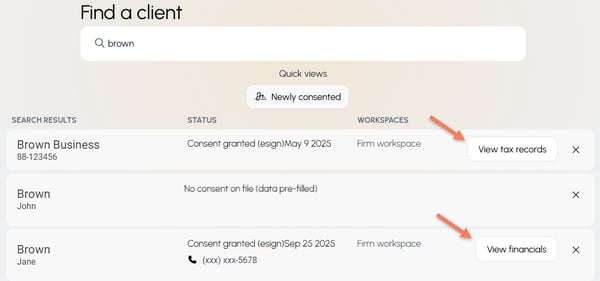
Search for a client from your Home page, then choose View financials for an individual or View records for a business.
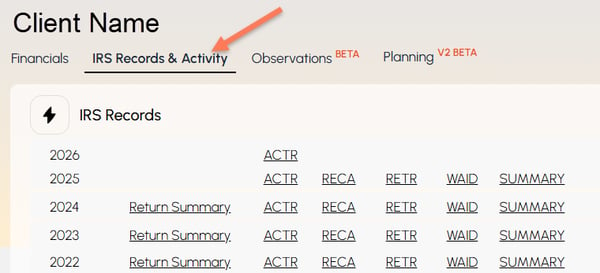
For an individual, choose the IRS Records & Activity tab under their name.
Transcript Types
- Tax Return Transcript (RETR): Shows most line items from a filed Form 1040, along with line items or summaries for accompanying forms and schedules. Created only after a return has been filed.
- Retention: Past 4 years
- Account Transcript (ACTR): Summarizes basic transactional data on file with the IRS: filing status, extensions filed, total income, adjusted gross income, taxable income, net taxable income, payments made, refunds issued, balance due for the period, and changes made after the original return was filed.
- For individuals, also includes tax per return and self-employment taxable income.
- For businesses, also includes tax per return, net receipts, and total deductions.
- Retention: Up to 25 years
- Record of Account Transcript (RECA): Combines the Tax Return Transcript and Account Transcript into one complete record. Only generated if a Tax Return Transcript exists.
- Retention: Past 4 years
- Wage & Income Transcript (WAID): Shows data from information returns, including income from Forms W-2, 1098, 1099, and 5498, plus IRA contributions, RMDs, and fair market values.
- Limited to approximately 85 income documents.
- Generally populates from May through late June for the prior tax year.
- Retention: Up to 10 years
- Wage & Income Summary (SUMMARY): Summarizes income sources from the Wage & Income Transcript by category, such as wages, interest, and Social Security wages and withholdings.
- May change if the Wage & Income Transcript changes
- Retention: Up to 10 years
Tips
- If a client's Wage & Income data looks incomplete for a recent tax year, check the timing — for most taxpayers, this transcript type doesn't fully populate until late spring/early summer. For taxpayers waiting on K-1s, this file continues to update as the IRS receives and populates additional information.
- When a spouse asks why their Account Transcript looks the same as their partner's, this is expected for jointly filed returns — only Wage & Income Transcripts differ by individual.